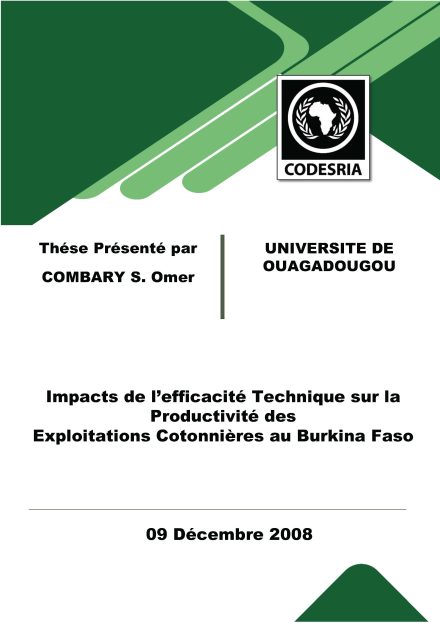
Impacts de l’efficacité Technique sur la Productivité des Exploitations Cotonnières au Burkina Faso
2023
Abstract views : 206 Downloads : 25

CODESRIA Books Publication System
This historical study explores the development of the World Council of Churches’ (WCC) Programme to Combat Racism (PCR), 1969–1994, and its campaign against apartheid in South Africa. It demonstrates how church-state relations can be understood as ‘resistance’, but takes the analysis further by arguing that the PCR, as an external transnational, ecumenical lobby with intimate links to South African political radicalism, as well as exiled militant formations among the liberation movements, sanctified revolutionary action in dealing with white supremacy. It succeeded in marshalling a broad range of international opinion by creating an agency dedicated to the eradication of racism within the structures of the WCC. Increasingly diverse membership enabled it to act decisively outside the constraints of pre-eminent Western interests, theology and diplomacy, drawing more directly on strands of Liberation Theology and the politics of non-alignment.
The thesis, based on extensive archival research in Geneva and South Africa, covers the growing activism of the PCR in the 1970s and 1980s, tracing its aims, projects and achievements under the various WCC general Assemblies at Uppsala, Nairobi, Vancouver and Canberra between 1968 and 1991. The PCR applied multiple strategies to attack apartheid, including special funding to the African National Congress, Pan Africanist Congress and South African Congress of Trade Unions, action research and anti-racism programmes to inform and influence churches in different parts of the world to join the antiapartheid struggle.
The WCC and PCR provided a space for debate across a range of ideological contestation. This was a function of its location in Geneva, its broad ecumenism and its openness to representing the interests of oppressed communities. Its attraction to political action, civil society lobbies and philanthropic enterprises contributed to its effectiveness as a ‘think tank’ for liberation, distinct from defined party-political forums or secular international human rights agencies. It therefore represented a ‘clearing house’ for ideas about democratic transformation and social change. Even though the PCR drew fire for its support of armed struggle, it succeeded in fostering dialogue among liberals and radicals, opposing political factions and competing international interests in rethinking South Africa’s future between 1969 and 1994.

APA Mufamadi, T. D. (2023). The World Council of Churches and its Programme to Combat Racism: The Evolution and Development of their Fight against Apartheid, 1969–1994. CODESRIA. https://doi.org/10.57054/codesria.pub.1022
Chicago Mufamadi, Thembeka Doris. The World Council of Churches and its Programme to Combat Racism: The Evolution and Development of their Fight against Apartheid, 1969–1994. Dakar: CODESRIA, 2023. https://doi.org/10.57054/codesria.pub.1022.
MLA Mufamadi, Thembeka Doris. The World Council of Churches and its Programme to Combat Racism: The Evolution and Development of their Fight against Apartheid, 1969–1994. CODESRIA, 2023. https://doi.org/10.57054/codesria.pub.1022.
2023
Abstract views : 206 Downloads : 25
2023
Abstract views : 210 Downloads : 24
2023
Abstract views : 105 Downloads : 26
2023
Abstract views : 153 Downloads : 20
2023
Abstract views : 103 Downloads : 21
2023
Abstract views : 121 Downloads : 39
2023
Abstract views : 67
2023
Abstract views : 144 Downloads : 12
2023
Abstract views : 70 Downloads : 202
2023
Abstract views : 113 Downloads : 11
2023
Abstract views : 56 Downloads : 3