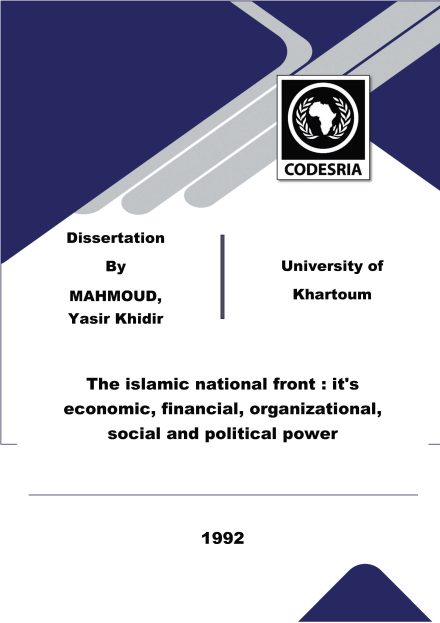
The islamic national front : it's economic, financial, organizational, social and political power
2023
Abstract views : 115 Downloads : 18

CODESRIA Books Publication System
The emphasis on Farmer Groups (FGs) is to develop a demand driven and farmer led Agricultural Advisory Services (AAS) delivery mechanism that is responsive to the challenges of ‘poor’ farmers who cannot absorb the costs of individual participation. In Uganda, the National Agricultural Advisory Services (NAADS) was started and as such, is meant to transform and empower farmers through their groups to gain access to and have control over Agricultural Extension Services (AES). However, the disincentives inherent in group approaches have continued to render the approach ineffective. There are farmers who have continuously avoided farmer groups in spite of the fact that the approach is believed to lower the delivery and purchasing costs of AES. The study assessed formation dynamics of FGs, perceptions of farmers about the two approaches as
well as the motivations and constraints inherent in each approach and lastly the benefits that accrue to farmers from participating as groups or individuals. The study was conducted in Nakaseke district and used a case study of FGs under the NAADS programme; in addition, it used the descriptive survey methods (semi-structured questionnaire and interview guides) in collecting data. There were some initial misunderstandings by farmers about NAADS. Farmers expected to get free farm inputs
which led to formation of false groups. Group formation largely depended on friendship and family ties, gender and level of farming resources and men controlled group activities. The very poor and the rich were absent in group activities. Notably from the research findings, NAADS is not addressing the pride of the resource poor farmers with no farm resources and are excluded from participating in farmer groups. The implementation of NAADS has concentrated more on theoretical training than producing tangible commercial farm outputs that would empower farmers financially and encourage their participation and ownership of the programme. It is therefore necessary for NAADS and other development partners harmonize the programme to include the resource poor farmers and bring them into programme activities. NAADS should empower farmer groups either by strengthening farmer grass root farmer institutions so that government and donor funding flows directly to these groups and should as much as possible encourage farmers to raise own funds to supplement government or donor funds.
APA BA, K. J. (2009). IMPLICATIONS OF FARMING APPROACHES FOR FARMERS’ WELLBEING: A COMPARATIVE STUDY OF GROUP AND INDIVIDUAL FARMING PRACTICES IN NAKASEKE DISTRICT, UGANDA. CODESRIA. https://doi.org/10.57054/codesria.pub.1644
Chicago BA, KYEBUZIBWA JOSEPH. IMPLICATIONS OF FARMING APPROACHES FOR FARMERS’ WELLBEING: A COMPARATIVE STUDY OF GROUP AND INDIVIDUAL FARMING PRACTICES IN NAKASEKE DISTRICT, UGANDA. Dakar: CODESRIA, 2009. https://doi.org/10.57054/codesria.pub.1644.
MLA BA, KYEBUZIBWA JOSEPH. IMPLICATIONS OF FARMING APPROACHES FOR FARMERS’ WELLBEING: A COMPARATIVE STUDY OF GROUP AND INDIVIDUAL FARMING PRACTICES IN NAKASEKE DISTRICT, UGANDA. CODESRIA, 2009. https://doi.org/10.57054/codesria.pub.1644.
2023
Abstract views : 115 Downloads : 18
2023
Abstract views : 108 Downloads : 48
2023
Abstract views : 94 Downloads : 64
2023
Abstract views : 88 Downloads : 27
2023
Abstract views : 108 Downloads : 30
2023
Abstract views : 106 Downloads : 46
2023
Abstract views : 120 Downloads : 22
2023
Abstract views : 120 Downloads : 59
2023
Abstract views : 148 Downloads : 60
2023
Abstract views : 81
2023
Abstract views : 92 Downloads : 15
2023
Abstract views : 104 Downloads : 10