
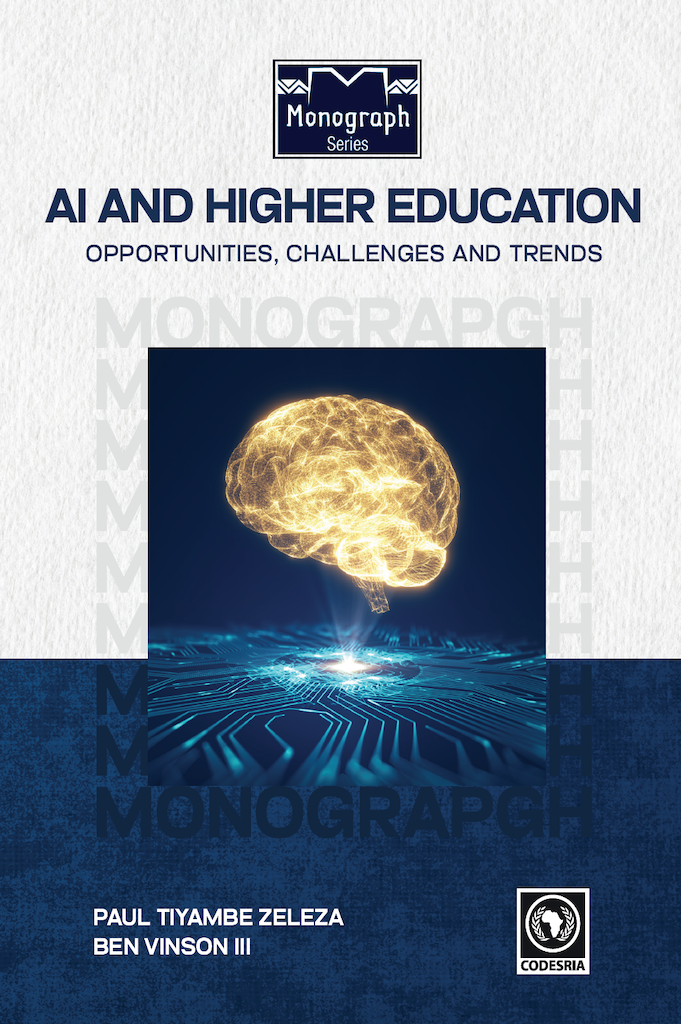
AI and Higher Education : Opportunities, Challenges and Trends
Synopsis
ISBN: 978-2-38234-105-6
AI and Higher Education: Opportunities, Challenges and Trends explores the profound transformation artificial intelligence is unleashing across global universities. From redefining teaching, research, and administration to reshaping relationships among students, faculty, staff, and leadership, AI has become a pervasive force and a reality demanding urgent response. This timely and incisive monograph examines AI’s place in historical context, maps regional adoption trends across continents, and critically analyzes how institutions are responding. It highlights not only the potential benefits of AI in enhancing learning and operations, but also the ethical, cultural, and environmental dilemmas it raises. Offering strategic guidance on policy, governance, and innovation, the monograph equips key stakeholders in higher education with the tools to engage AI thoughtfully and equitably in the academy. Drawing on comparative global examples and interdisciplinary research, it identifies both risks and opportunities. Bridging global perspectives with practical recommendations, this is an essential guide for educators, administrators, policymakers, and anyone invested in the future of higher education.
Extract from endorsements
Excellent and Timely Publications!
This excellent and timely work on artificial intelligence and universities arrives at a critical juncture, as the global higher education sector grapples with the opportunities, uncertainties, and ethical dilemmas posed by rapidly evolving AI technologies. Rather than offering a narrow or overly technical treatment of the subject, this volume adopts a refreshingly comprehensive approach—drawing on perspectives from multiple continents to present a well-rounded and comparative account of how AI is being understood, adopted, and contested across different higher education systems. Particularly commendable is the work’s focus on the university as a unique and complex institutional space where teaching, research, governance, and community engagement intersect—and where the integration of AI cannot be separated from fundamental questions about academic integrity, institutional values, and social responsibility. By systematically engaging the views of diverse stakeholders—faculty, students, administrators, and policymakers—it avoids the common trap of techno-solutionism. Instead, it offers nuanced, context-sensitive strategies for developing AI policies and programs in higher education. As an academic who facilitates a graduate-level course on technology and higher education, I find this volume to be of immense pedagogical and professional value. Its succinct, rigorous analysis and global scope make it essential reading not only for graduate students and scholars, but also for institutional leaders, administrators, and policymakers seeking to navigate this complex terrain. In a moment where AI threatens to outpace regulatory and ethical reflection, this monograph serves as a vital resource for those committed to shaping a more thoughtful, inclusive, and future-ready higher education landscape.
Damtew Teferra, PhD
Professor of Higher Education, University of Kwazulu-Natal; Founding Director and Board Chair, International Network for Higher Education in Africa; Editor-in-Chief, International Journal of African Higher Education; and Co-Coordinator, CESA-Higher Education Cluster, African Union Commission
Timely! Comprehensive! Informative!
In an epoch whose contours and depths have increasingly been defined by the developments and transformations in artificial intelligence, this monograph by Paul Tiyambe Zeleza and Ben Vinson III is an important contribution to the understanding of how AI is developing, challenging, and disrupting thought, systems, and practices in higher education in Africa and beyond. This important pioneering contribution comes at a moment when Africa and its higher education ecosystem cannot wait a minute longer to shape how artificial intelligence determines social, economic, cultural, and political life. It also highlights how changes and practices within artificial intelligence contribute to these determinants.
This highly informative work provides an introduction and broad comparative overview of the technical elements, innovation, and investments in artificial intelligence. It also engages debates on ethics, access, accountability, and the epistemologies of AI as they apply to higher education across different regions of our contemporary world.
Tade Aina, PhD
Higher Education Scholar, Poet, Foundation Executive Senior Program Director, Africa Program, Carnegie Corporation of New York
As higher education enters the age of artificial intelligence, AI and Higher Education provides a clear and compelling guide for institutional leaders seeking to navigate this transformation with purpose and vision. The monograph offers a comprehensive and balanced assessment of how AI is reshaping teaching, research, operations, and governance across colleges and universities worldwide.
With insight and precision, it examines how institutions can align curricula with emerging industry needs, safeguard intellectual property, and empower faculty, staff, and students to harness AI responsibly. It underscores the importance of building the infrastructure, policies, and partnerships necessary to ensure that innovation serves the enduring mission of education.
Drawing from global perspectives, AI and Higher Education calls on those within and beyond academia to steward AI thoughtfully, advancing discovery, innovation, and human potential while positioning higher education at the forefront of an intelligent and inspiring future that helps create a better world.
Talitha M. Washington, PhD, DSc,
Executive Director, Center for Applied Data Science and Analytics, Sean McCleese Endowed Chair, and Professor of Mathematics, Howard University
Downloads
Download data is not yet available.
Downloads
Published
November 26, 2025
Series
Copyright (c) 2025 CODESRIA Books Publication System