Mosaïques hiérarchisées d’écosystèmes artificiels (MHEA®) comme outil stratégique de gestion des eaux usées : Cas de Douala au Cameroun
2023
Abstract views : 148 Downloads : 60

CODESRIA Books Publication System
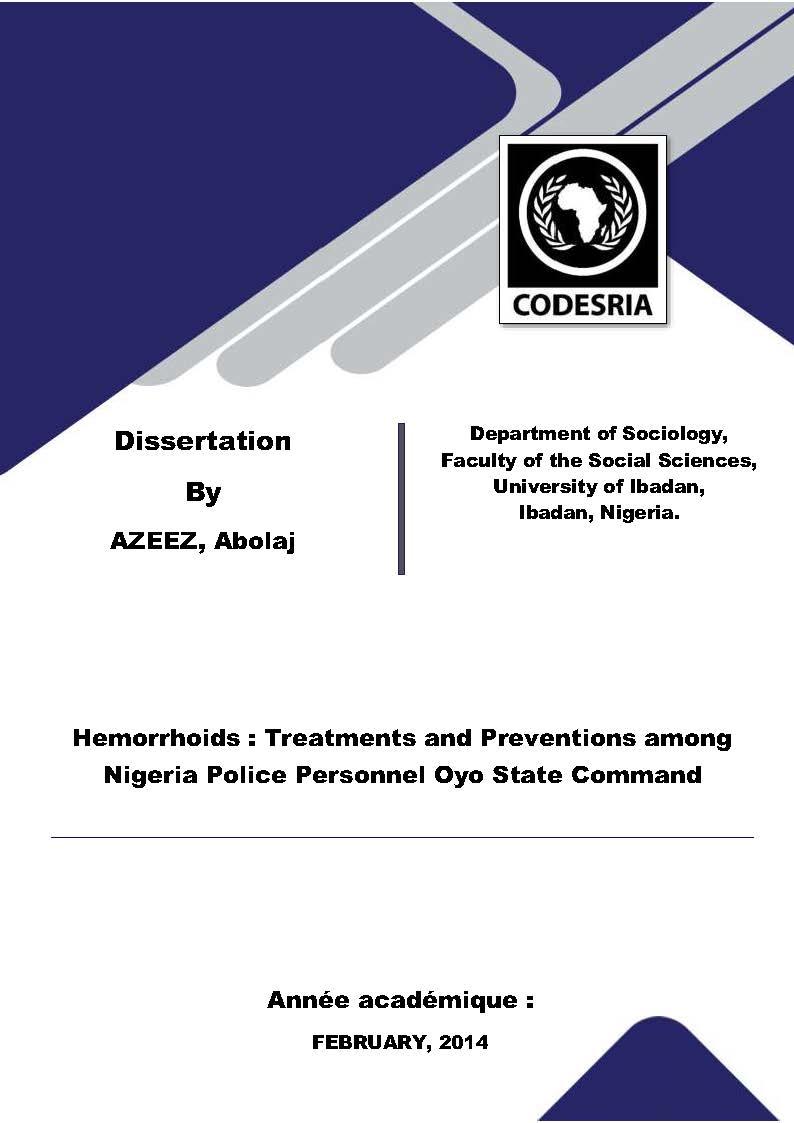
Hemorrhoid or pile culturally known as Jedijedi among people of south-western Nigeria, is an
anorectal disease with high prevalence breaking every social status coupled with several
misconceptions about its causes, effects and treatments. It is a common cause of distress and its
treatment is often unsatisfactory due to its recurrence or complications. The predisposing factors
includes any form of straining, poor bowel habit, constipation, standing and sitting for a long
time, age among others while its aftermath ranges from anal itching, protrusion, bleeding, feeling
of incomplete defecation to inability to stand or sit for long. Policing exposes officers to
stress, standing or sitting for long and walking continuously, which increase their likelihood of
developing hemorrhoids. Culturally, until it becomes problematic, people may not take necessary
action. Therefore, the mainthrust of the study is to understand the social cultural explanation of
piles among Nigerian police officers.
An exploratory survey design was utilized to investigate the sociocultural construction of
hemorrhoids, causes, prevention, treatments and coping strategies among members of Nigeria Police
Force Oyo State Command. For the study, 302 available on-duty and consenting police officers were
recruited through multistage sampling technique. In stage one, the Nigeria Police Force Oyo State
Command was purposively selected. Secondly, the study area is clustered into four groups according
to the four existing area commands. The selection of Divisional Police Headquarters was purposive,
based on the size of personnel in each police station. Also, 98 exit interviews were conducted at
selected areas. In addition, 5 consenting key informants were selected and interviewed at the study
area considering profession and proximity, to represent orthodox and alternative medicine vendors.
Data were subjected to chi-square and content analysis.
Results indicated high prevalence rate among respondents. The majority (73.5%) of the respondents
had poor awareness of the risk factors stating that sugar intake was responsible for piles which
was unfounded scientifically. The belief negatively influenced the treatment adopted, because they
had nothing to do with hemorrhoids. Thus, the recurrence of hemorrhoids is inevitable. Piles
affected work negatively among the respondents but contrary to popular belief, hemorrhoid was not
responsible for poor sexual strength or backache. Also, the use of herbal medicine for pile was as
a result of the cost of treatments, fear of hemorrhoidectomy; over 60% of the officers used herbal
treatment only coupled with 30% of them opted for both herbal and modern therapies, while the
religious affiliation of officers did influence the kind of herbal remedy used. Furthermore,
orthodox practitioners and herbal vendors have areas of conflicting interests over the explanation
of hemorrhoid and its effects.
The study suggested that sensitization is a potent tool to combat ignorance about hemorrhoids.
Lastly, government should provide an environment where herbal endors and
orthodox practitioners can synthesize their efforts to treat hemorrhoid effectively.
APA Abolaj, A. (2023). Hemorrhoids : Treatments and Preventions among Nigeria Police Personnel Oyo State Command. CODESRIA. https://doi.org/10.57054/codesria.pub.1401
Chicago Abolaj, AZEEZ,. Hemorrhoids : Treatments and Preventions among Nigeria Police Personnel Oyo State Command. Dakar: CODESRIA, 2023. https://doi.org/10.57054/codesria.pub.1401.
MLA Abolaj, AZEEZ,. Hemorrhoids : Treatments and Preventions among Nigeria Police Personnel Oyo State Command. CODESRIA, 2023. https://doi.org/10.57054/codesria.pub.1401.
2023
Abstract views : 148 Downloads : 60
2023
Abstract views : 115 Downloads : 18
2023
Abstract views : 108 Downloads : 48
2023
Abstract views : 94 Downloads : 64
2023
Abstract views : 88 Downloads : 27
2023
Abstract views : 108 Downloads : 30
2023
Abstract views : 106 Downloads : 46
2023
Abstract views : 120 Downloads : 22
2023
Abstract views : 120 Downloads : 59
2023
Abstract views : 104 Downloads : 10
2023
Abstract views : 81
2023
Abstract views : 92 Downloads : 15