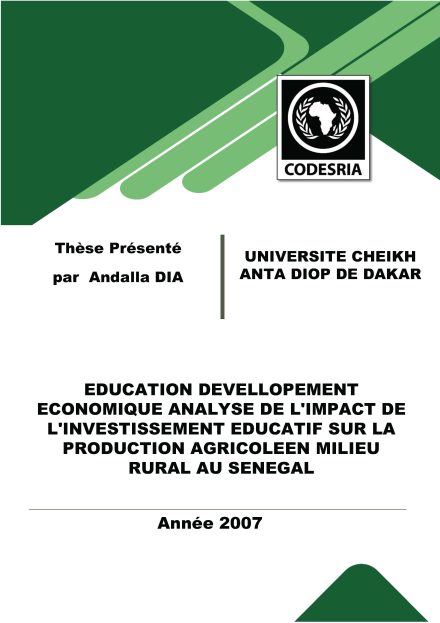
Education et développement économique : analyse de l'impact de l'investissement éducatif sur la productivité agricole en milieu rural au Sénégal
2023
Abstract views : 210 Downloads : 24

CODESRIA Books Publication System
Studies have shown that women are a minority in non-traditional careers, have slow career growth compared to their male colleagues and almost invisible in leadership positions, therefore excluded in power structure. These have been attributed to culture, socialisation,conditioning and self-perception of the women themselves. However, predicting factors of female academics’ career in Nigerian Universities are yet to be examined. This study, therefore, affirmed the efficacy or otherwise of psycho-social and organisational climate factors as predictors of female academics’ career growth and leadership positions in
universities in South-West Nigeria.
The study employed both quantitative and qualitative research methodologies. The quantitative aspect adopted the survey research design of the ex-post facto. Multistage sampling involving the use of purposive and stratified random techniques were used to select 898 respondents from six Universities in South-West Nigeria. Five hundred and thirty eight Female Academics from Graduate Assistant to Professor, three hundred male academics, (senior lecturers) sixty members of appointment and promotion committee participated in the study. Female Academics Psychological Questionnaire (R=0.82), Social Factors Questionnaire (R=0.87), Organisational Climate Factors Questionnaire (R=0.84), Female Academics Career Growth Questionnaire (R=0.79) and Female Academics Leadership Questionnaire (r=0.84) were used for data collection. These were
complemented with 27 in-depth interviews with female Professors. Twelve research questions were answered. Data were analysed using multiple regression and content analysis.
Psychological factors (self-esteem and self-efficacy), social factors (parental influence, spousal support, male academics collegial support and attitude towards women, as well as organisational climate factors (fairness, inclusion, work climate) had positive multiple correlation with career growth of female academics (R=0.40) and explained 14.2% of the variance in the dependent variable. The three categories of factors also jointly correlated with leadership position of female academics (R=0.55), and explained 28.5% of the dependent measure. The factors which made the highest contributions to career growth
are: self-efficacy (β =.28), parental influence (β=.22) and spousal support (β=.18) while for leadership position they are parental influence (β=.36), attitude towards women (β=.27) and self-efficacy (β=.25) in that order. Further, self-efficacy (B=.40; t=6.59; p <
.05), parental influence (B= -.12; t= -4.89; p<.05) and spousal support (B=.13; t=4.26; p<.05) could predict career growth. Predictors of female academics’ leadership position include parental influence (B= -.22; t= -9.10; p<.05), self-efficacy (B=.370; t=6.316; p<.05), spousal support (B= .169; t = 5.673; p<.05) and work climate (B= .56; t =2.03; p<.05). In-depth interviews revealed that female academics are self-conscious of their minority status, and perceive they work twice as hard as their male colleagues. They are aware that support and positive attitudes from male colleagues, their spouses, parents and favourable work climate are essential for their career growth and the attainment ofleadership positions.
Significant factors of female academics’ career growth are self-efficacy, parental influence and spousal support, while parental influence, academic men’s attitude towards women, self-efficacy, and work climate are essential towards their attainment of leadership positions. Therefore, female academics must develop positive self-efficacy, seek the support of their husbands and male colleagues. Also, universities should create a favourable work climate for all staff.

APA OTI, A. O. (2023). PSYCHO-SOCIAL AND ORGANISATIONAL CLIMATE FACTORS AS PREDICTORS OF FEMALE ACADEMICS’ CAREER GROWTH AND LEADERSHIP POSITION IN SOUTHWEST NIGERIAN UNIVERSITIES. CODESRIA. https://doi.org/10.57054/codesria.pub.1464
Chicago OTI, ADEPEJU OLAIDE. PSYCHO-SOCIAL AND ORGANISATIONAL CLIMATE FACTORS AS PREDICTORS OF FEMALE ACADEMICS’ CAREER GROWTH AND LEADERSHIP POSITION IN SOUTHWEST NIGERIAN UNIVERSITIES. Dakar: CODESRIA, 2023. https://doi.org/10.57054/codesria.pub.1464.
MLA OTI, ADEPEJU OLAIDE. PSYCHO-SOCIAL AND ORGANISATIONAL CLIMATE FACTORS AS PREDICTORS OF FEMALE ACADEMICS’ CAREER GROWTH AND LEADERSHIP POSITION IN SOUTHWEST NIGERIAN UNIVERSITIES. CODESRIA, 2023. https://doi.org/10.57054/codesria.pub.1464.
2023
Abstract views : 210 Downloads : 24
2023
Abstract views : 206 Downloads : 25
2023
Abstract views : 121 Downloads : 39
2023
Abstract views : 105 Downloads : 26
2023
Abstract views : 153 Downloads : 20
2023
Abstract views : 103 Downloads : 21
2023
Abstract views : 56 Downloads : 3
2023
Abstract views : 67
2023
Abstract views : 144 Downloads : 12
2023
Abstract views : 70 Downloads : 202
2023
Abstract views : 113 Downloads : 11