L’APPORT DES TECHNOLOGIES DE L’INFORMATION ET DE LA COMMUNICATION DANS LES ACTIVITES DOCUMENTAIRES DE L’UNIVERSITE MARIEN NGOUABI
2023
Abstract views : 106 Downloads : 46

CODESRIA Books Publication System
This study is an attempt to assess fertility levels and family planning practices in a rural Nigerian community@ It utilized survey data gathered from 312 wo~en aged 15-49 years. In all, eleven hypotheses were tested using chi-square and Analysis of variance test instruments"'It was found that the ideal family size in the community is 6 children per woman. When the effect of mortality on fertility is controlled, the ideal family sizè came down to 5.4 children per woman. Infant and child mortality was found to be very low, approximating 905 children per 100 births and this appears to have a long history within the community. we discovered that the community's social norms, which e~phasizes trainingof children acts as a check on high fertility levels, keeping it at levels which income and available resources can adequately take care of. This provide adequate care for children and hence low levels of child mortalitye
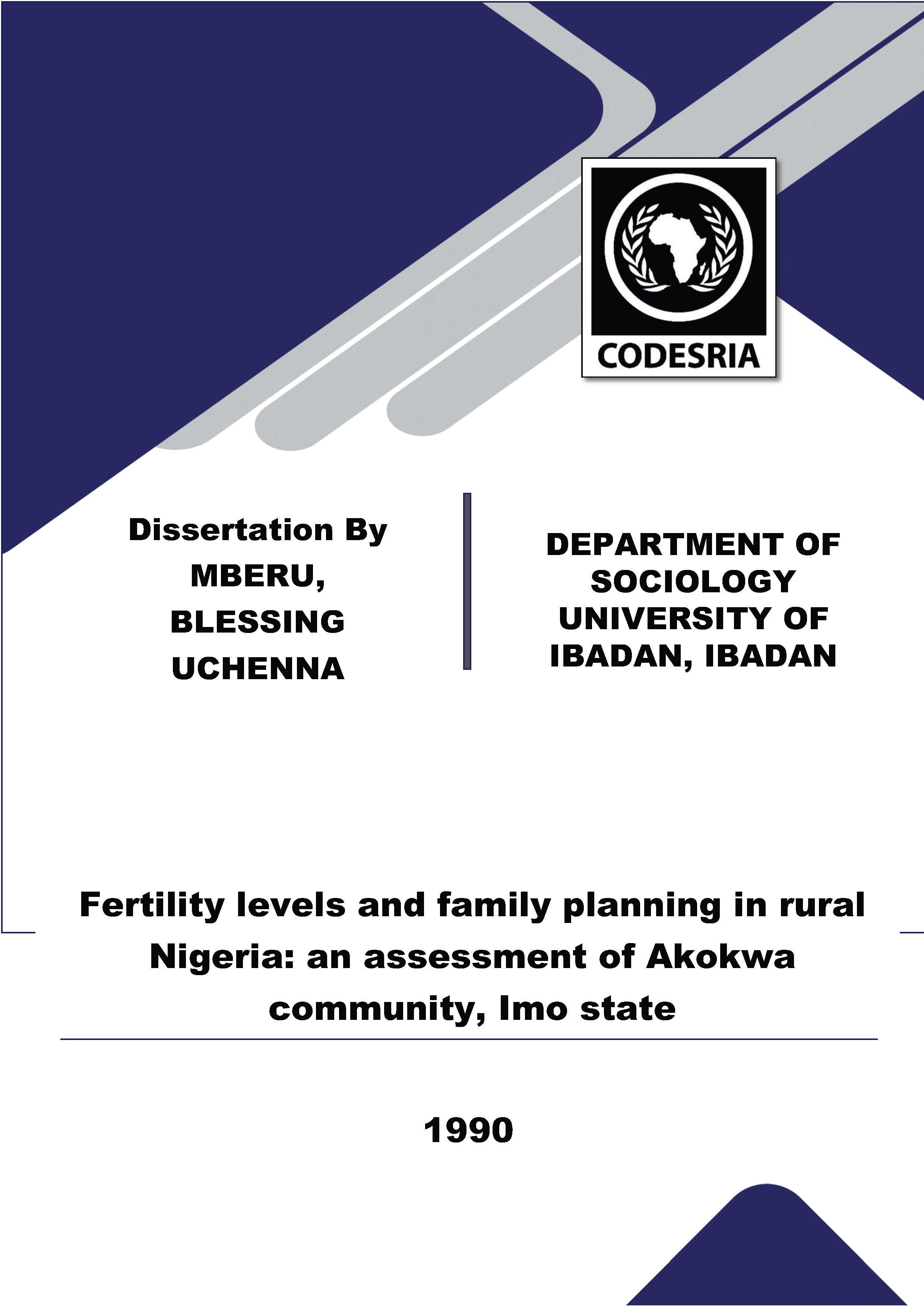
APA MBERU, B. U. (1995). Fertility levels and family planning in rural Nigeria: an assessment of Akokwa community, Imo state. CODESRIA. https://doi.org/10.57054/codesria.pub.1787
Chicago MBERU, BLESSING UCHENNA. Fertility levels and family planning in rural Nigeria: an assessment of Akokwa community, Imo state. Dakar: CODESRIA, 1995. https://doi.org/10.57054/codesria.pub.1787.
MLA MBERU, BLESSING UCHENNA. Fertility levels and family planning in rural Nigeria: an assessment of Akokwa community, Imo state. CODESRIA, 1995. https://doi.org/10.57054/codesria.pub.1787.
2023
Abstract views : 106 Downloads : 46
2023
Abstract views : 120 Downloads : 22
2023
Abstract views : 120 Downloads : 59
2023
Abstract views : 148 Downloads : 60
2023
Abstract views : 115 Downloads : 18
2023
Abstract views : 108 Downloads : 48
2023
Abstract views : 94 Downloads : 64
2023
Abstract views : 88 Downloads : 27
2023
Abstract views : 108 Downloads : 30
2023
Abstract views : 92 Downloads : 15
2023
Abstract views : 104 Downloads : 10
2023
Abstract views : 81