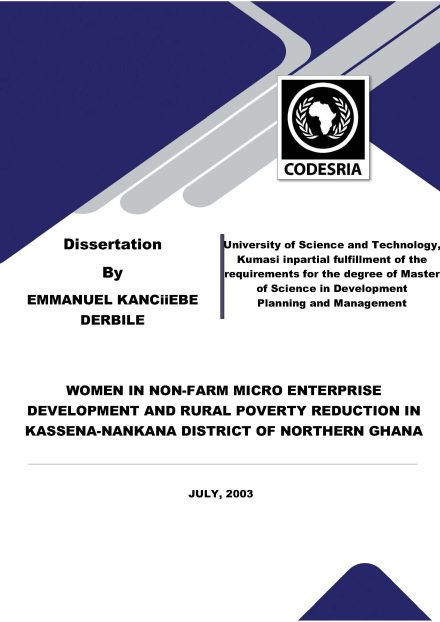
Women in non farm micro enterprise development and rural poverty reduction in Kassena-Nankana district of northern Ghana
2023
Abstract views : 108 Downloads : 48

CODESRIA Books Publication System
Climate change is the most important risk affecting agricultural production in Ethiopia. Farmers
have adapted different copping and/or adaptation strategies to climate change. A better
understanding of climate change induced agricultural production risks, farmers’ perceptions of
climate change, ongoing adaptation measures, and their decision making process is essential in the
adaptive policy formulation process. In line with this, using three period panel data for 2005,
2007 and 2011years from survey of 204 farm households in four kebeles of Wolaita, SNNPR, this study
presents the different sources of risks, the adaptation strategies used by farmers, the determinant
factors influencing the decision to adopt SWC structures and analyze the impact of SWC adoption on
farmers production using Endogenous Switching Regression Models. About 79 % of the farmers
perceived that there was climate change in terms of rainfall shortage and increase in temperature
in the last six years compared to the previous times. This was also confirmed by the values of the
meteorological station data collected for 60 years in the study area. In response farmers in the
study site have undertaken adaptation strategies such as Soil and Water Conservation, crop
diversification (multiple cropping), fertilizer application, improved variety usage and changing
planting dates. Household Fixed Effect Switching Regression model was used to see the determinant
factors affecting the choice of SWC adaptation, the impact of SWC adoption on crop production and
observe the temporal and cross sectional variability between SWC adopter and non adopter groups.
According to the first stage of the model result, labour in man days, household size, extension
contact on SWC, livestock holding in TLU, plot slope being mid hill have positive and significant
impact on choice of SWC adaptation to climate change. Variables such as education level, farming
experience, average annual rainfall, plot ownership, soil type being dark brown, plot slope being
steep, erosion susceptibility, and no soil degradation have negative and significant impact on SWC
adoption decision. The second stage model result indicates that there is positive and statistically
significant difference in terms of production in value terms between SWC adopters and non adopters.
Plots with SWC structures tend to produce about 1060 birr per ha more to 3979 birr per ha in
production than plots which did not have such structures. Moreover, they also differ in terms of
major household characteristics, and conventional input usage. This study concludes that climate
change is the major source of risk affecting crop production negatively and adoption of SWC
adaptation strategies to climate change have significant
impact on crop production to farm households in the study area.

APA Kalkidan, A. (2023). SOURCES OF RISK AND IMPACT OF CLIMATE CHANGE ADAPTATION STRATEGY ON CROP PRODUCTION:: THE CASE OF SOIL AND WATER CONSERVATION IN WOLAITA, SOUTHERN HIGHLANDS OF ETHIOPIA. CODESRIA. https://doi.org/10.57054/codesria.pub.676
Chicago Kalkidan, ASSEFA,. SOURCES OF RISK AND IMPACT OF CLIMATE CHANGE ADAPTATION STRATEGY ON CROP PRODUCTION:: THE CASE OF SOIL AND WATER CONSERVATION IN WOLAITA, SOUTHERN HIGHLANDS OF ETHIOPIA. Dakar: CODESRIA, 2023. https://doi.org/10.57054/codesria.pub.676.
MLA Kalkidan, ASSEFA,. SOURCES OF RISK AND IMPACT OF CLIMATE CHANGE ADAPTATION STRATEGY ON CROP PRODUCTION:: THE CASE OF SOIL AND WATER CONSERVATION IN WOLAITA, SOUTHERN HIGHLANDS OF ETHIOPIA. CODESRIA, 2023. https://doi.org/10.57054/codesria.pub.676.
2023
Abstract views : 108 Downloads : 48
2023
Abstract views : 94 Downloads : 64
2023
Abstract views : 88 Downloads : 27
2023
Abstract views : 108 Downloads : 30
2023
Abstract views : 106 Downloads : 46
2023
Abstract views : 120 Downloads : 22
2023
Abstract views : 120 Downloads : 59
2023
Abstract views : 148 Downloads : 60
2023
Abstract views : 115 Downloads : 18
2023
Abstract views : 81
2023
Abstract views : 92 Downloads : 15
2023
Abstract views : 104 Downloads : 10