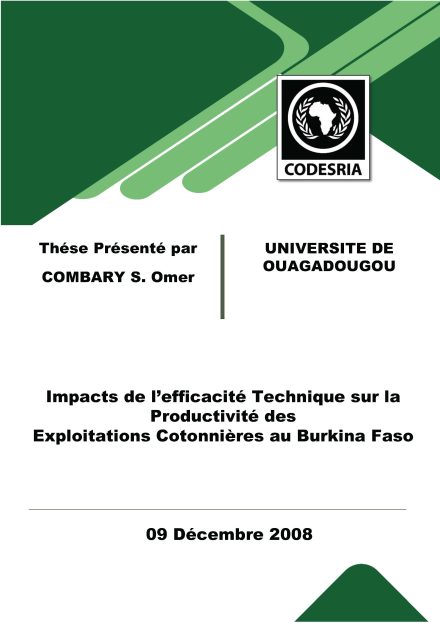
Impacts de l’efficacité Technique sur la Productivité des Exploitations Cotonnières au Burkina Faso
2023
##plugins.themes.clarte.stats.views## : 206 ##plugins.themes.clarte.stats.downloads## : 25

CODESRIA Books Publication System
In Anglophone Cameroon like elsewhere in Cameroon, women have been oppressed by men in most aspects of life, access to land inclusive. Although the societies from which such patriarchal laws are found have evolved to respond to changing socio-economic and other aspects of life, issues touching on women’s equal access to land have more often met with stiff resistance. Access to land has been a contentious and perennial problem in Anglophone Cameroon for women both at the family and community levels. Apparently, access to land use by women poses little or no problem in the country. The problem however is the restriction on women’s access to land for ownership which carries with it the legal right to use and control land independently. This has created the problem of a lopsided pattern of access to land which is heavily tilted in favour of males to the disadvantage of women. This inequality carries profound negative consequences on women for the additional reasons that women are more involved in agricultural activities for family sustenance than men. This discrimination is a costly constraint on their productivity and a barrier to equitable growth, peace and sustainable development of the region. Cameroon being a country of law, both the customary and statutory laws play a greater role in regulating equal access to land in the Anglophone region. Nevertheless, the statutory land laws reflect the rules of formal equality in accessing land and this rule has not protected the inherent land rights of majority of the population who are mostly women living in the rural areas. The study finds the rules of formal equality adopted by the statutory rules instead of the rules of substantive equality falling short in the protection of equal access to land for both men and women in the region. This has stimulated the candidate to investigate if there exist some elements of inequality in our statutory land laws that accounts for the restriction of access to land experienced by women or are there some socio-economic challenges faced by women in accessing land in relation to men who are similarly situated as human beings? The study is carried out specifically in the Anglophone Regions of Cameroon and it employs both the primary and secondary sources of information, questionnaires and interview guides to collect data. Findings reveal that
less than 10% of women own land in the Anglophone region. Also, it is discovered that although Cameroon is apparently a democratic country upholding the principle of good governance and prioritizing the enforcement of an equitable access to land by everyone in its land laws, the country has not instituted any meaningful machinery to address the difficulties faced by majority of the population in enjoying access to land as a constitutional right. Thus, this study upholds the policy of paying particular attention to the land rights of women in the region. This is because according to the Libertarians, the right to property (land inclusive) to human beings is fundamental on the basis that God gave the earth as a common heritage to his children to be used according to their needs. It is on this premise that the concept of equality which is situated within the natural law theory requires that everyone is bound to respect and recognize the equal right of all no matter the normative set up of any given society. Hence, this study will stimulate positive action in the management of land and to improve the existing machinery for acquiring land on an equal basis. This research will to this extent contribute to the introduction of reforms in the domain of land laws to eradicate the prevalent injustice experienced by women as evidenced by the current uneven distribution of land in the region.

APA Munge, S. P. (2023). THE CONCEPT OF EQUALITY AND ACCESS TO LAND: THE CASE OF THE ANGLOPHONE REGIONS OF CAMEROON. CODESRIA. https://doi.org/10.57054/codesria.pub.1044
Chicago Munge, Sone Patience. THE CONCEPT OF EQUALITY AND ACCESS TO LAND: THE CASE OF THE ANGLOPHONE REGIONS OF CAMEROON. Dakar: CODESRIA, 2023. https://doi.org/10.57054/codesria.pub.1044.
MLA Munge, Sone Patience. THE CONCEPT OF EQUALITY AND ACCESS TO LAND: THE CASE OF THE ANGLOPHONE REGIONS OF CAMEROON. CODESRIA, 2023. https://doi.org/10.57054/codesria.pub.1044.
2023
##plugins.themes.clarte.stats.views## : 206 ##plugins.themes.clarte.stats.downloads## : 25
2023
##plugins.themes.clarte.stats.views## : 210 ##plugins.themes.clarte.stats.downloads## : 24
2023
##plugins.themes.clarte.stats.views## : 121 ##plugins.themes.clarte.stats.downloads## : 39
2023
##plugins.themes.clarte.stats.views## : 105 ##plugins.themes.clarte.stats.downloads## : 26
2023
##plugins.themes.clarte.stats.views## : 153 ##plugins.themes.clarte.stats.downloads## : 20
2023
##plugins.themes.clarte.stats.views## : 103 ##plugins.themes.clarte.stats.downloads## : 21
2023
##plugins.themes.clarte.stats.views## : 194
2023
##plugins.themes.clarte.stats.views## : 67
2023
##plugins.themes.clarte.stats.views## : 144 ##plugins.themes.clarte.stats.downloads## : 12
2023
##plugins.themes.clarte.stats.views## : 70 ##plugins.themes.clarte.stats.downloads## : 202
2023
##plugins.themes.clarte.stats.views## : 113 ##plugins.themes.clarte.stats.downloads## : 11
2023
##plugins.themes.clarte.stats.views## : 56 ##plugins.themes.clarte.stats.downloads## : 3