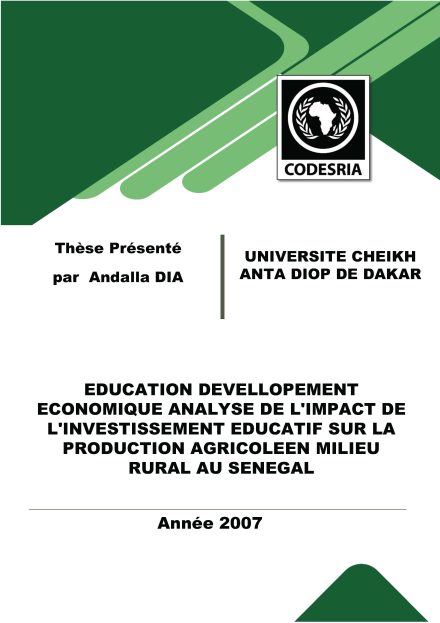
Education et développement économique : analyse de l'impact de l'investissement éducatif sur la productivité agricole en milieu rural au Sénégal
2023
##plugins.themes.clarte.stats.views## : 210 ##plugins.themes.clarte.stats.downloads## : 24

CODESRIA Books Publication System
This dissertation examines the gender digital divide in the Information and Communication Technology (ICT) industry in Uganda by analysing admission and graduation dynamics among men and women in ICT degree programs at Makerere and Busitema Universities and the transition of ICT graduates from university to work with specific focus on Mobile Telecommunication Network- Uganda (MTN-Uganda) and Uganda Telecom Limited (UTL) companies. It explores the socio-cultural stereotypes and perceptions that influence the participation and progress of women professionals in the ICT industry and examines the diverse ways in which women in the ICT industry respond to these stereotypes and perceptions. A qualitative research design and methodology was employed to realise these objectives. The data which informed this study was obtained through detailed in-depth interviews and focus group discussions, analysis of admission, graduation and employment data, and official reports. The study reveals that the way socio-cultural structures and institutions are set up — often in favour of men over women — as well as the differential construction of both women and men — inferior feminine vis-à-vis superior masculine — particularly, in a predominantly patriarchal Ugandan society, continue to shape and inform the uptake of ICTs in the country.
The dissertation shows that more men than women are admitted into ICT degree programs at Makerere and Busitema universities. Gender ‘appropriateness’, role models, failure to attain minimum admission requirements, influence of parents and misconception about ICT work variously influence career choice among men and women. Employment patterns among men and women in the ICT industry indicate that the top managerial and technical positions are largely dominated by men while women constitute many of employees at low level, less technical positions. Transition patterns also show that the numbers of women gradually reduce at each critical career transition point. Gender related socio-cultural stereotypes such as male scientist vis-à-vis technophobic woman, working man vis-à-vis domesticated woman, and dependent woman vis-à-vis independent man underlie these paradoxes. These disempowering’ socially constructed labels continue to obstruct many of women from participating in the ICT industry. Finally, this thesis has revealed that a wide range of ‘everyday’ response mechanisms including juggling family and work responsibilities, subterfuge, negotiating, sacrificing career for family, as well adopting the ‘culture of men in technology’ are deployed by women to navigate and challenge the existing socio-cultural stereotypes and constructions which accentuate the gender digital divide in Uganda.
APA Mwondha, P. (2023). TOWARDS BRIDGING THE ‘GENDER DIGITAL DIVIDE’ IN UGANDA: A Study of University to Work Transition Patterns among ICT graduates. CODESRIA. https://doi.org/10.57054/codesria.pub.1088
Chicago Mwondha, Priscilla. TOWARDS BRIDGING THE ‘GENDER DIGITAL DIVIDE’ IN UGANDA: A Study of University to Work Transition Patterns among ICT graduates. Dakar: CODESRIA, 2023. https://doi.org/10.57054/codesria.pub.1088.
MLA Mwondha, Priscilla. TOWARDS BRIDGING THE ‘GENDER DIGITAL DIVIDE’ IN UGANDA: A Study of University to Work Transition Patterns among ICT graduates. CODESRIA, 2023. https://doi.org/10.57054/codesria.pub.1088.
2023
##plugins.themes.clarte.stats.views## : 210 ##plugins.themes.clarte.stats.downloads## : 24
2023
##plugins.themes.clarte.stats.views## : 206 ##plugins.themes.clarte.stats.downloads## : 25
2023
##plugins.themes.clarte.stats.views## : 121 ##plugins.themes.clarte.stats.downloads## : 39
2023
##plugins.themes.clarte.stats.views## : 105 ##plugins.themes.clarte.stats.downloads## : 26
2023
##plugins.themes.clarte.stats.views## : 153 ##plugins.themes.clarte.stats.downloads## : 20
2023
##plugins.themes.clarte.stats.views## : 103 ##plugins.themes.clarte.stats.downloads## : 21
2023
##plugins.themes.clarte.stats.views## : 194
2023
##plugins.themes.clarte.stats.views## : 67
2023
##plugins.themes.clarte.stats.views## : 144 ##plugins.themes.clarte.stats.downloads## : 12
2023
##plugins.themes.clarte.stats.views## : 70 ##plugins.themes.clarte.stats.downloads## : 202
2023
##plugins.themes.clarte.stats.views## : 113 ##plugins.themes.clarte.stats.downloads## : 11
2023
##plugins.themes.clarte.stats.views## : 56 ##plugins.themes.clarte.stats.downloads## : 3