Mémoires

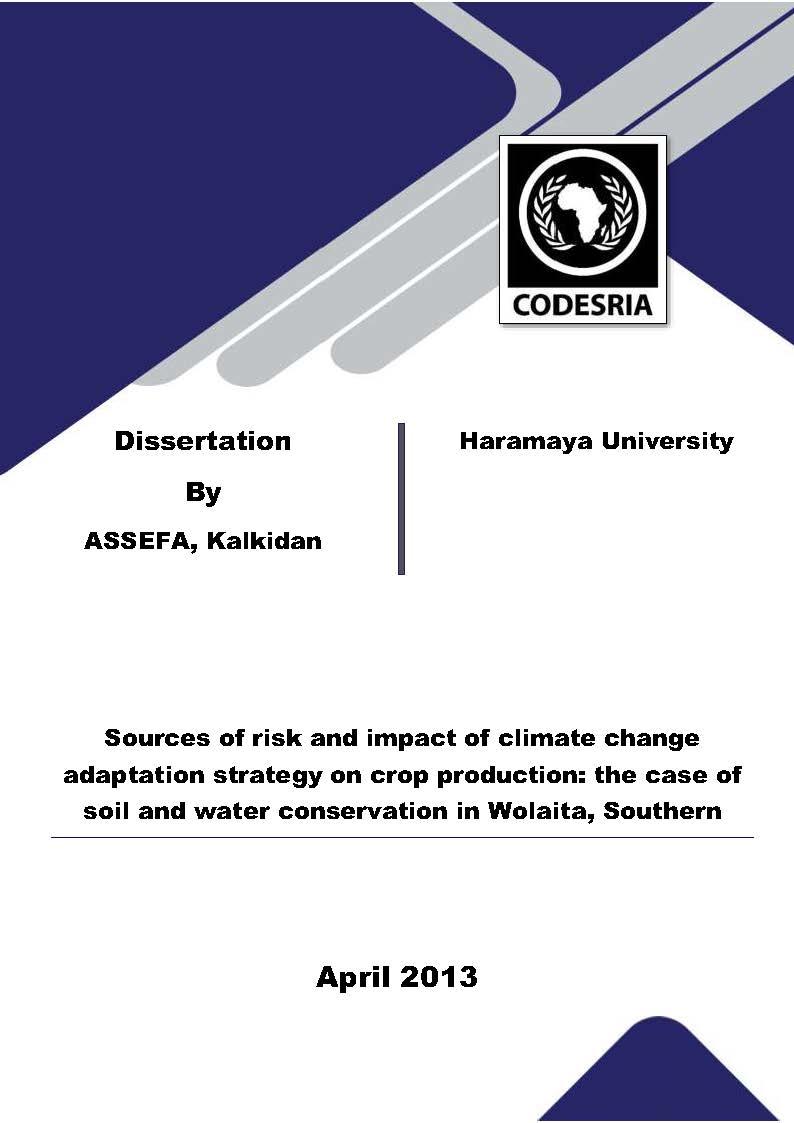
SOURCES OF RISK AND IMPACT OF CLIMATE CHANGE ADAPTATION STRATEGY ON CROP PRODUCTION:: THE CASE OF SOIL AND WATER CONSERVATION IN WOLAITA, SOUTHERN HIGHLANDS OF ETHIOPIA

Auteurs-es

ASSEFA, Kalkidan
stagiaire

Synopsis

Climate change is the most important risk affecting agricultural production in Ethiopia. Farmers
have adapted different copping and/or adaptation strategies to climate change. A better
understanding of climate change induced agricultural production risks, farmers’ perceptions of
climate change, ongoing adaptation measures, and their decision making process is essential in the
adaptive policy formulation process. In line with this, using three period panel data for 2005,
2007 and 2011years from survey of 204 farm households in four kebeles of Wolaita, SNNPR, this study
presents the different sources of risks, the adaptation strategies used by farmers, the determinant
factors influencing the decision to adopt SWC structures and analyze the impact of SWC adoption on
farmers production using Endogenous Switching Regression Models. About 79 % of the farmers
perceived that there was climate change in terms of rainfall shortage and increase in temperature
in the last six years compared to the previous times. This was also confirmed by the values of the
meteorological station data collected for 60 years in the study area. In response farmers in the
study site have undertaken adaptation strategies such as Soil and Water Conservation, crop
diversification (multiple cropping), fertilizer application, improved variety usage and changing
planting dates. Household Fixed Effect Switching Regression model was used to see the determinant
factors affecting the choice of SWC adaptation, the impact of SWC adoption on crop production and
observe the temporal and cross sectional variability between SWC adopter and non adopter groups.
According to the first stage of the model result, labour in man days, household size, extension
contact on SWC, livestock holding in TLU, plot slope being mid hill have positive and significant
impact on choice of SWC adaptation to climate change. Variables such as education level, farming
experience, average annual rainfall, plot ownership, soil type being dark brown, plot slope being
steep, erosion susceptibility, and no soil degradation have negative and significant impact on SWC
adoption decision. The second stage model result indicates that there is positive and statistically
significant difference in terms of production in value terms between SWC adopters and non adopters.
Plots with SWC structures tend to produce about 1060 birr per ha more to 3979 birr per ha in
production than plots which did not have such structures. Moreover, they also differ in terms of
major household characteristics, and conventional input usage. This study concludes that climate
change is the major source of risk affecting crop production negatively and adoption of SWC
adaptation strategies to climate change have significant
impact on crop production to farm households in the study area.
##plugins.themes.clarte.stats.title##

##plugins.themes.clarte.metrics.views##
30
##plugins.themes.clarte.stats.downloads##
13

##plugins.themes.clarte.cites.title##

Biographie de l'auteur-e

ASSEFA, Kalkidan, stagiaire

The author was born on April 27, 1983 in Meki town, East Shewa Zone of the Oromia Region. He
attended his elementary and Junior Secondary educations at Kidane Meheret Catholic Elementary
School, and attended his secondary education at Lideta Catholic Cathedral School, Addis Ababa. Upon
completion of his high school studies, he joined Mekelle University in 2002/2003 for his BSc degree
and graduated with BSc degree in Natural Resource Economics and Management on July 2006. Right
after his graduation, the author was employed in International Water Management Institute (IWMI) as
Research Assistant and worked for two years and International Livestock Research Institute (ILRI)
and Save the Children (SC-UK) for short periods. Then after he joined Ethiopian Institute of
Agricultural Research, Assosa Center (EIAR-ASARC) as Junior Socioeconomics Researcher and has
served for about 3 years. After having five years of work experience in different institutions, he
joined the School of Graduate Studies of Haramaya
University for his MSc degree, Agricultural Economics in October, 2010.

Références

  1. Adane T., Alemu M., Zenebe G., and Assefa S., 2012. Climate convention and Africa/ Ethiopia.
  2. Ethiopian Development Research Institute research report 15. Addis Ababa, Ethiopia.
  3. Adugna Eneyew., 2008. Livelihood strategies and food security in Wolaita, Southern Ethiopia: the
  4. case of Boloso Sore District. M.Sc. Thesis Presented to School of Graduate, Haramaya University,
  5. Ethiopia.
  6. Ahmed, is. Dhaka:
  7. Climate
  8. Ajayi, O d financial
  9. profitabilit actices in
  10. Zambia.
  11. Aklilu A hazards,
  12. impacts for Social
  13. Studies (
  14. Alley, R. , Gregory,
  15. J.,Hegerl, ttsov, V.,
  16. Lohmann, D., Raga,
  17. G., Ram .F., Stott,
  18. P.A., Sto nsen, J.H.,
  19. Denman, ., Lemke,
  20. P., Meeh Zwiers, F.
  21. t of the
  22. Intergove cretariat :
  23. Geneva,
  24. Amsalu, of Stone
  25. Terraces Ecological
  26. Economi
  27. Anley, Y f soil and
  28. water c Western
  29. Ethiopia. Land Degradation and Development 18, 289–302.
  30. Asfaw A. and Assefa Admassie, 2004. The role of education on the adoption of chemical fertilizer
  31. under different socio-economic environment in Ethiopia. Agricultural Economics, 30(3): 215-228.
  32. Australian Greenhouse Office. 2003: Climate Change – An Australian Guide to the Science and
  33. Potential Impacts, edited by Barrie Pittock.
  34. Bayard, B, Jolly, CM & Shannon, DA, 2007. The economics of adoption and management of
  35. alley cropping in Haiti. Journal of Environmental Management 84, 62–70.
  36. Bekele, S., and S. Holden. 1999. “Soil Erosion and Sma l Holders’ Conservation Decisions in the
  37. Ethiopian Highlands,” World Development 24(4): 739–52.
  38. Bekele, S., and S. Holden. 2001. “Farm-Level Benefits to Investments for Mitigating Land
  39. Degradation: Empirical Evidence from Ethiopia,” Environment Development Economics 6(3): 335–58.
  40. Bekele, Land and
  41. Water xperience.”
  42. Environ
  43. Benin, S Use, and
  44. Productio ble Land
  45. Manage S. Ehui.
  46. Washingt
  47. Berhanu ed for the
  48. Roles of
  49. Berkes, ence in a
  50. Canadian
  51. Birhanu, Yields and
  52. Farm Pr f Soil and
  53. Water C
  54. Birhanu, iopia: The
  55. Role of L .
  56. Birungi, Uganda.
  57. PhD thes Faculty of
  58. Natural a
  59. Blanco, ew York:
  60. Springer.
  61. Boko M, Niang I, Nyong A, Vogel C, Githeko A, Medany M, Osman-Elasha B, Tabo R, Yanda P (2007).
  62. Impacts, adaptation and vulnerability. Contribution of Working Group II to the Fourth Assessment
  63. Report of the Intergovernmental Panel on Climate Change. Cambridge University Press, Cambridge, UK,
  64. p 433-467
  65. Bush, J., 2002. Baseline Report on Household Food Economy Assessment: Boloso sore woreda, Wolaita
  66. Zone SNNPR, Action for Development (AFD).
  67. Cameron, A., Trivedi,K., 2009. Micro econometrics using STATA. Published by Stata Press,
  68. Texas, USA.
  69. Campbell, A., 2008. Managing Australian Landscapes in a Changing Climate a Climate Change Primer
  70. for Regional Natural Resource Management Bodies. Department of Climate Change.
  71. Carter, D. W., and J. W. Milon. 2005. Price Knowledge in Household Demand for Utility Services.
  72. Land Economics 81(2): 265–283.
  73. CEEPA,2006. Climate Change and African Agriculture Policy Note No. 10,, Centre for Environmental
  74. Economics and Policy in Africa (CEEPA), University of Pretoria, South Africa.
  75. Chan, K ign Direct
  76. Investme
  77. Chilot Yi gement in
  78. Central Agricultural
  79. Economic
  80. Christens won W-T,
  81. Laprise P (2007)
  82. Regional nt Report
  83. of the In idge, UK,
  84. p 847-94
  85. Clay, D, nd tropics:
  86. Rwandan pment and
  87. Cultural
  88. CSA, 20 s, Federal
  89. Democrat Ethiopia.
  90. CSA, 20
  91. Darwin, nd climate
  92. change: Research
  93. Service,
  94. Devereux emergency
  95. needs assessments. World Food Program, Emmergency Needs Assessment Branch.
  96. Di Falco, S. and J.P. Chavas, 2009. On Crop Biodiversity, Risk Exposure and Food Security in the
  97. Highlands of Ethiopia. American Journal of Agricultural Economics, 91(3): 599-611.
  98. Di Falco, S., M. Veronesi and M. Yesuf, 2011. Does Adaptation to Climate Change Provide Food
  99. Security? A micro-Perspective from Ethiopia. American Journal of Agricultural Economics, vol: 1-18.
  100. Dolisca, F, Carter, RD, McDaniel, JM, Shannon, DA & Jolly, CM, 2006. Factors influencing farmers’
  101. participation in forestry management programs: A case study from Haiti. Forest Ecology and
  102. Management 236, 324-31.
  103. Endrias Geta, 2003. Adoption of Improved Sweet potato varieties in Boloso Sore woreda, Southern
  104. Ethiopia. A thesis submitted to the school of graduate studies for the partial fulfillment of the
  105. degree of Msc. in Agricultural Economics, Alemaya University.
  106. FAO. 2007. Adaptation to climate change in agriculture, forestry and fisheries: Perspective,
  107. framework and priorities. Rome, Italy, 32 p. ftp://ftp.fao.org/docrep/fao/009/j9271e/j9271e.pdf
  108. FAO, 20 Technical
  109. backgrou
  110. FDRE, 2 per. Addis
  111. Ababa, E
  112. Feder, of New
  113. Technolo
  114. Feder, G Developing
  115. Countries
  116. Franzel, oved tree
  117. fallows i
  118. Franzel, impact of
  119. agrofores 1-3): 329-
  120. Funk , rn Africa.
  121. FEWS-N
  122. Girma Te th Eastern
  123. Ethiopia: Studies of
  124. Alemaya
  125. Gissila T n summer
  126. rains. int.
  127. Gould, BW, Saupe, WE & Klemme, RM, 1989. Conservation tillage: The role of farm and operator
  128. characteristics and the perception of soil erosion. Land Economics 65, 167–82.
  129. Greene, W.H., 2003. Econometric analysis. 5th Edition. Prentice Hall, New Jersey.
  130. Grepperud, S. 1996. Population Pressure and Land Degradation: The Case of Ethiopia. Journal of
  131. Environmental Economics and Management 30(1): 18–33.

Téléchargements

##catalog.published##

juin 26, 2023

Langue

Anglais

Séries

Renseignements à propos de cette monographie

Dimensions physiques

##plugins.themes.clarte.press.citeBook##

APA Kalkidan, A. (2023). SOURCES OF RISK AND IMPACT OF CLIMATE CHANGE ADAPTATION STRATEGY ON CROP PRODUCTION:: THE CASE OF SOIL AND WATER CONSERVATION IN WOLAITA, SOUTHERN HIGHLANDS OF ETHIOPIA. CODESRIA. https://doi.org/10.57054/codesria.pub.676

##plugins.themes.clarte.press.otherStyles##

Chicago Kalkidan, ASSEFA,. SOURCES OF RISK AND IMPACT OF CLIMATE CHANGE ADAPTATION STRATEGY ON CROP PRODUCTION:: THE CASE OF SOIL AND WATER CONSERVATION IN WOLAITA, SOUTHERN HIGHLANDS OF ETHIOPIA. Dakar: CODESRIA, 2023. https://doi.org/10.57054/codesria.pub.676.

MLA Kalkidan, ASSEFA,. SOURCES OF RISK AND IMPACT OF CLIMATE CHANGE ADAPTATION STRATEGY ON CROP PRODUCTION:: THE CASE OF SOIL AND WATER CONSERVATION IN WOLAITA, SOUTHERN HIGHLANDS OF ETHIOPIA. CODESRIA, 2023. https://doi.org/10.57054/codesria.pub.676.

##plugins.themes.clarte.press.shareBook##