Impacts de l’efficacité Technique sur la Productivité des Exploitations Cotonnières au Burkina Faso
2023
Abstract views : 206 Downloads : 25

CODESRIA Books Publication System
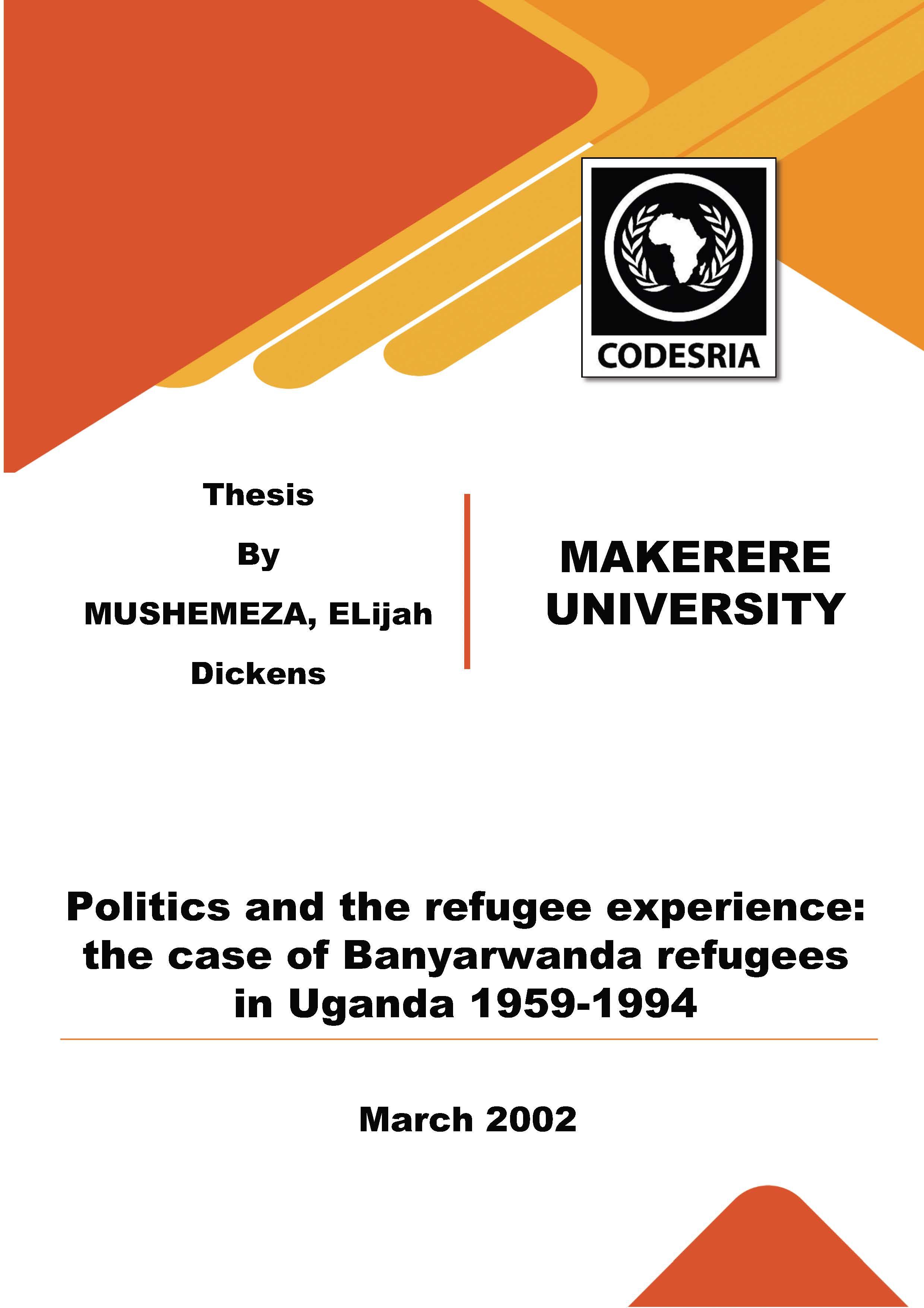
This thesis attempts to interprete the experiences of the Banyarwanda refugees from a historical perspective. lt analyses and explains the struggle of the Banyarwanda refugees to regain their rights as citizens of Rwanda and to escape from the trials and tribulations of refugee status. The thesis also analyses why and how Banyarwanda refugees in Uganda organised themselves to empower themselves to return to their homeland. lt also draws lessons from the Banyarwanda refugee experience not only for Rwanda and Uganda but also the entire Great Lakes region of Africa, and indeed for the entire continent.
The study employed an appropriate methodology in which the research design was conceived and developed from a historical perspective. Thus, a case study design is used in order to study a single group (Banyarwanda refugees) for a period of lime.
As a result, the study mainly employed qualitative methods of data collection and analysis namely: interviews, focus group discussions; and construction of themes, hypotheses, and the use of good arguments so that those themes and hypotheses are reasonable.
The research established that the Banyarwanda refugees achieved reasonable levels of integration in the Ugandan society because of similar demographic, social, economic and cultural characteristics with the Ugandan population in the parts where they settled. If the Ugandan state had not broken down in the late 1970s and 1980s, these refugees would have, perhaps acquired naturalisation - a veritable form of empowerment. However, although the ordinary Tutsi refugees achieved integration, their leaders and some of the elites never gave up the dream of returning home. The challenge was how to realise that dream. lndeed, the opportunities eventually emerged in the context of the civil war in Uganda (1981-86). This is when Banyarwanda refugees joined the NRM/NRA struggle that enabled them to acquire political, diplomatie and military skills which
they used effectively to achieve their empowerment ambitions.
The research findings show that the Banyarwanda refugees formed the RPF and the RPA while still in Uganda. This was possible because the refugees had identified and mastered the weaknesses in the Ugandan society and turned them into opportunities for themselves. Since their leaders had been in positions of responsibility in the Ugandan state machinery, white others had been successful as traders and farmers, the Banyarwanda refugees covertly strengthened themselves economically, socially, militarily, culturally and politically so that few Ugandans suspected that preparations were underway between 1987 and 1990 to invade Rwanda.
The thesis concludes that the understanding of the Banyarwanda refugee question is very important for Rwanda, the Great Lakes region, and Africa, as a whole. Unless African states learn how to build institutions that allow popular participation in decision making, transfer of political power from one group or generation to another, and generally, address the question of democracy and good governance, the creation of refugees will be unavoidable and this will sooner or later culminate into Rwanda like - upheavals of genocidal proportions.
APA Dickens, M. E. (2023). Politics and the refugee experience: the case of Banyarwanda refugees in Uganda 1959-1994. CODESRIA. https://doi.org/10.57054/codesria.pub.1069
Chicago Dickens, MUSHEMEZA, ELijah. Politics and the refugee experience: the case of Banyarwanda refugees in Uganda 1959-1994. Dakar: CODESRIA, 2023. https://doi.org/10.57054/codesria.pub.1069.
MLA Dickens, MUSHEMEZA, ELijah. Politics and the refugee experience: the case of Banyarwanda refugees in Uganda 1959-1994. CODESRIA, 2023. https://doi.org/10.57054/codesria.pub.1069.
2023
Abstract views : 206 Downloads : 25
2023
Abstract views : 210 Downloads : 24
2023
Abstract views : 121 Downloads : 39
2023
Abstract views : 105 Downloads : 26
2023
Abstract views : 153 Downloads : 20
2023
Abstract views : 103 Downloads : 21
2023
Abstract views : 56 Downloads : 3
2023
Abstract views : 67
2023
Abstract views : 144 Downloads : 12
2023
Abstract views : 70 Downloads : 202
2023
Abstract views : 113 Downloads : 11