Impacts de l’efficacité Technique sur la Productivité des Exploitations Cotonnières au Burkina Faso
2023
Abstract views : 206 Downloads : 25

CODESRIA Books Publication System
This study empirically examines the degree to which fluctuations in thè exchange rate are reflected in the domestic prices of traded goods in Nigeria. Since the adoption of the International Monetary Fund (IMF) and the World Bank (WB) adjustment programme in developing countries, many developing countries, particularly Nigeria, continue to experience exchange rate volatility.
Countries around the world display great diversity in both their production and consumption of both primary and manufactured commodities. As a result, one of the most important factors affecting the ability of domestic firms to compete with foreign firms in the domestic market is the relative price of domestic and foreign - produced goods. The effect of the exchange rate on this relative price, commonly known as 'exchange rate pass-through', has · been the subject of much recent research international trade.
The resilience. of the trade balances of major trading nations in the face of wild fluctuations in exchange rates have been prominent in recent policy debates. The hypothesis of purchasing power parity (PPP), at least its loosest form, that international
trade in goods should limit the fluctuations in the relative price of tradeable goods across countries, has been a central pillar of standard open macroeconomic models for many years. The hypothesis of purchasing power parity appears to give a very good account of the fluctuations in the international relative prices of gold, oil or several other traded commodities across countries, stated in terms of a common currency, are essentially constant.
The departure from this law occurs when for a given price of a traded good, changes in domestic price are not proportional to the changes in the exchange rate. It has been argued in the literature that trade in manufactured goods are characterised by imperfect competition, therefore, pricing would no longer be at marginal cost. So, firms charge mark-up over cost to eam above normal profit. However, the mark-up charged by firms over cost depends on many factors which include the degree of substitutability between the domestic and imported goods as determined by the degree of product differentiation and the degree of market integration or segmentation (see Goldberg and Knetter, 1997)...
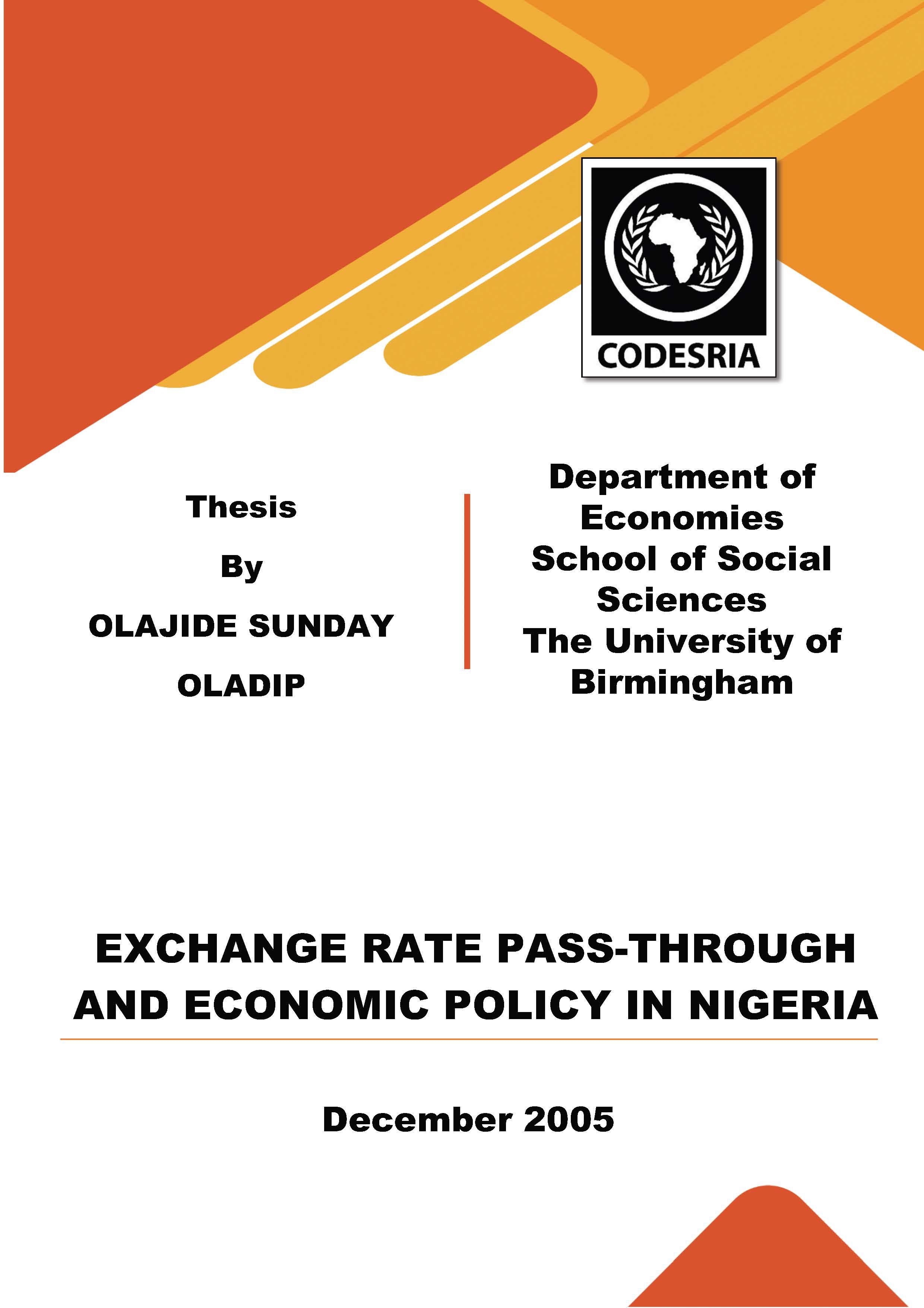
APA OLADIP, O. S. (2023). EXCHANGE RATE PASS-THROUGH AND ECONOMIC POLICY IN NIGERIA. CODESRIA. https://doi.org/10.57054/codesria.pub.1372
Chicago OLADIP, OLAJIDE SUNDAY. EXCHANGE RATE PASS-THROUGH AND ECONOMIC POLICY IN NIGERIA. Dakar: CODESRIA, 2023. https://doi.org/10.57054/codesria.pub.1372.
MLA OLADIP, OLAJIDE SUNDAY. EXCHANGE RATE PASS-THROUGH AND ECONOMIC POLICY IN NIGERIA. CODESRIA, 2023. https://doi.org/10.57054/codesria.pub.1372.
2023
Abstract views : 206 Downloads : 25
2023
Abstract views : 210 Downloads : 24
2023
Abstract views : 153 Downloads : 20
2023
Abstract views : 103 Downloads : 21
2023
Abstract views : 121 Downloads : 39
2023
Abstract views : 105 Downloads : 26
2023
Abstract views : 144 Downloads : 12
2023
Abstract views : 70 Downloads : 202
2023
Abstract views : 113 Downloads : 11
2023
Abstract views : 56 Downloads : 3
2023
Abstract views : 67