Impacts de l’efficacité Technique sur la Productivité des Exploitations Cotonnières au Burkina Faso
2023
Abstract views : 206 Downloads : 25

CODESRIA Books Publication System
Sexually Transmitted Infections (STis) are major causes of reproductive health and socio- economic problems world wide and they affect ail segments of the population including men, women and children. Statistics from the World Health Organisation (WHO) showed that an average of 685,000 new cases of infections occur everyday, while every year, there are 250 million new cases. These figures are estimated to increase annually. Adolescents have been identified as a group for whom the prevention of STis is an urgent necessity given the rislcy nature of sexual activities and lack of barrier contraceptive use among them. Although there are no adequate statistics on the prevalence of STis among adolescents in Nigeria, it is estimated that theyaccount for between 15 and 30 percent of al! reported cases of infections and often times, due to the exorbitant cost of procuring treatment, many of those infected do not seek health care from qualified medical personnel. In spite of the reality of STis as a major problem among adolescents, very little is known about their treatment seeking behaviour. For example, how do they cope with the problem of infection especially where they lad( access to adequate medical facilities?. In light of these, the study set out to achieve the following objectives: 1. Provide information on adolescents' knowledge of sexually transmittedinfections. 2. Examine the patterns of sexual behaviour among adolescents and the implications for the spread of infections.3. Examine how socio-demographic factors, including age, sex, education, residence, etc. will influence and thus determine attitudes to infections. 4. Estimate the prevalence of infections among adolescents and identify common infections among them. 5. Investfgate the coping strategies adopted by victims of infections and the implications for health seeking behaviour.6. Identify existing strategies adopted by victims of infections and the factors that determine the choice of a particular method of treatment. 7. Investigate the psycho-social consequences of infections on the victims and significant others. 8. Maloe policy recommendations for the control of infections among adolescents. The nature of the study necessitated a comparative study between urban and rural adolescents. A multistage sampling technique was utilised to select a total of 977 adolescents between the ages of 15 and 24 years to participate in a general survey and 200 adolescents of the same age category in a clinic survey. Respondents for the general survey were selected from Ibadan (defined as the urban area) and Tapa and Oolo; two rural communities located in Ifeloju and Ogbomosho South local government areas of Oyo State. In addition to the surveys,focus group discussions and cases studies of victims of infections were also conducted. The information collected was analysed by both quantitative and qualitative methods. Two theoretical models, the theory of Social Action and the Voluntaristic theory of Action, were used in providing explanations for the observed patterns of behaviour of adolescents with regard to STis. The findings showed that many adolescents ( 43. 7%) engage in irregular, unplanned and unprotected sexual activities and this tended to increase the rate of transmission of infections among them. Although the level of awareness of STis was high, (84% males vs. 86% an STI. In view of the findings, some recommendations which could guide the design of intervention programmes and policies to reduce, if not completely eliminate, the problem of STis were made. These recommendations include setting up intervention programmes that aim at behaviour modifications, provision of health education as a strategy for reducing the spread of infections. identifying individuals already infected and those at risk, recognising the important role ofpublic health care providers in the control of STis and finally, incorporating private sector health care providers in the efforts at controlling the spread of infections.
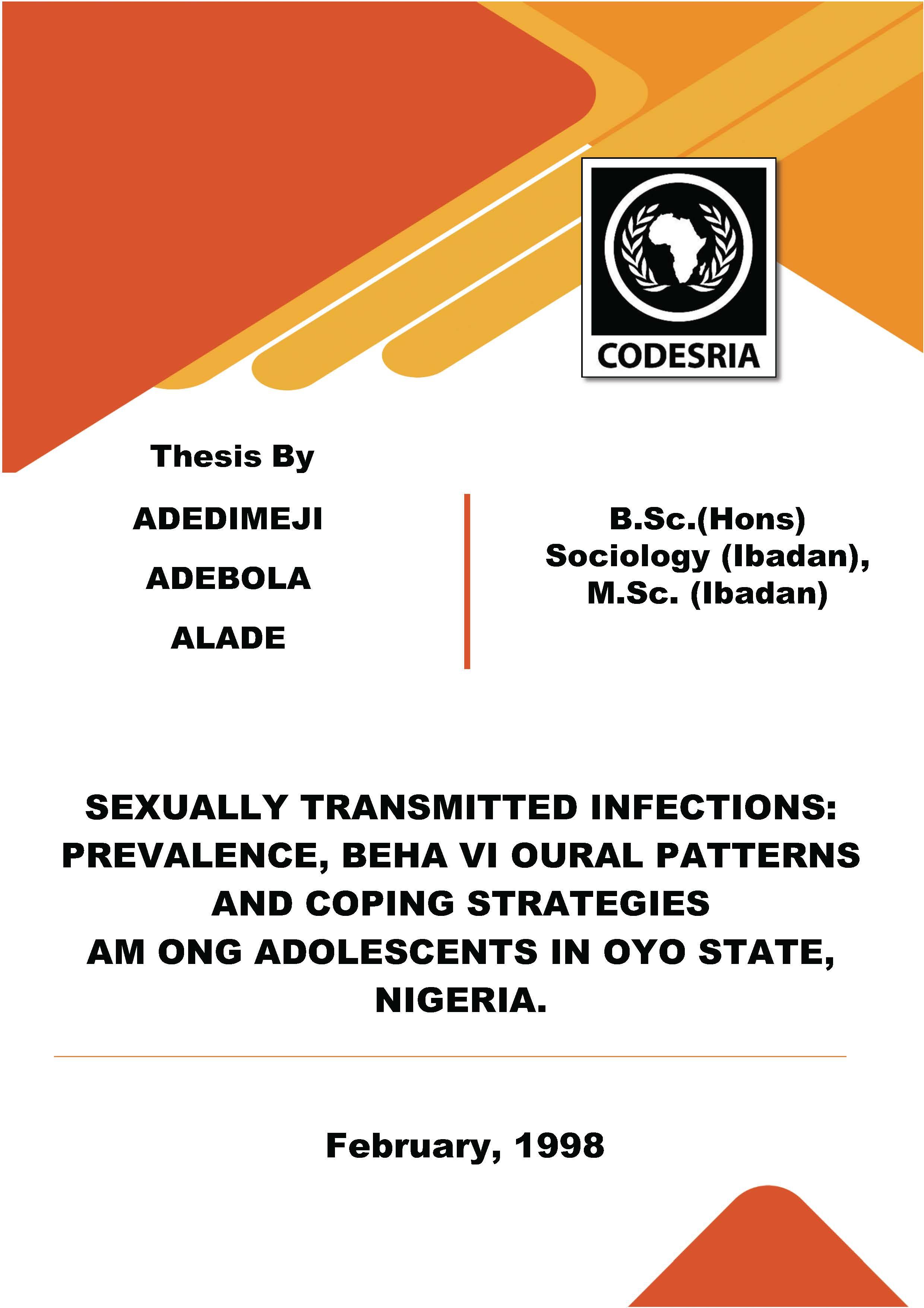
APA Adebola, A. A. (2023). Sexually, transmitted infections: prevalence, behavioural patterns and coping strategies among adolescents in oya state, Nigeria. CODESRIA. https://doi.org/10.57054/codesria.pub.911
Chicago Adebola, ALADE, Adedimeji. Sexually, transmitted infections: prevalence, behavioural patterns and coping strategies among adolescents in oya state, Nigeria. Dakar: CODESRIA, 2023. https://doi.org/10.57054/codesria.pub.911.
MLA Adebola, ALADE, Adedimeji. Sexually, transmitted infections: prevalence, behavioural patterns and coping strategies among adolescents in oya state, Nigeria. CODESRIA, 2023. https://doi.org/10.57054/codesria.pub.911.
2023
Abstract views : 206 Downloads : 25
2023
Abstract views : 210 Downloads : 24
2023
Abstract views : 103 Downloads : 21
2023
Abstract views : 121 Downloads : 39
2023
Abstract views : 105 Downloads : 26
2023
Abstract views : 153 Downloads : 20
2023
Abstract views : 70 Downloads : 202
2023
Abstract views : 113 Downloads : 11
2023
Abstract views : 56 Downloads : 3
2023
Abstract views : 67
2023
Abstract views : 144 Downloads : 12